Elecfreaks Micro:bit · Building Blocks
Building Blocks Kits

Nezha Inventors
Kit V2

A comprehensive STEAM engineering kit with 32 curriculum-aligned cases across 3 learning streams — Robots, Mechanical Engineering, and Smart Systems — powered by micro:bit with MakeCode and Python coding support.

🔒 Nezha Breakout Board V2 🔌 10 Sensors Included ⚙ 35+ Structural Parts 📚 32 Curriculum Cases
Request a Demo →
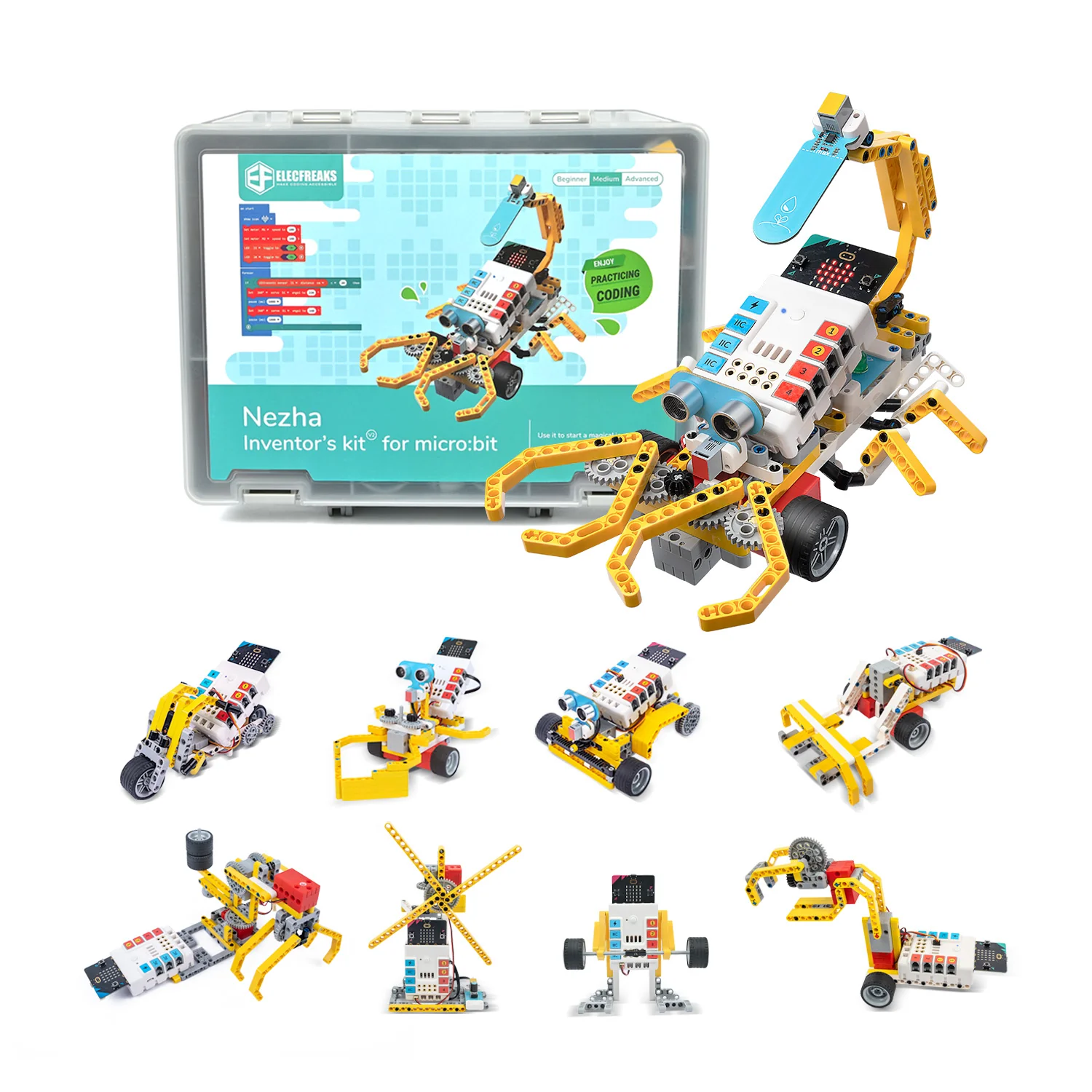
Nezha Inventors Kit V2 — full kit view
5–8
Grades
32
Cases
3
Streams
10
Sensors
What's Included

Everything students need to explore robotics, mechanical engineering, and smart systems — packaged and classroom-ready. Each component supports the full 32-case curriculum across 3 learning streams.

Nezha Breakout Board V2
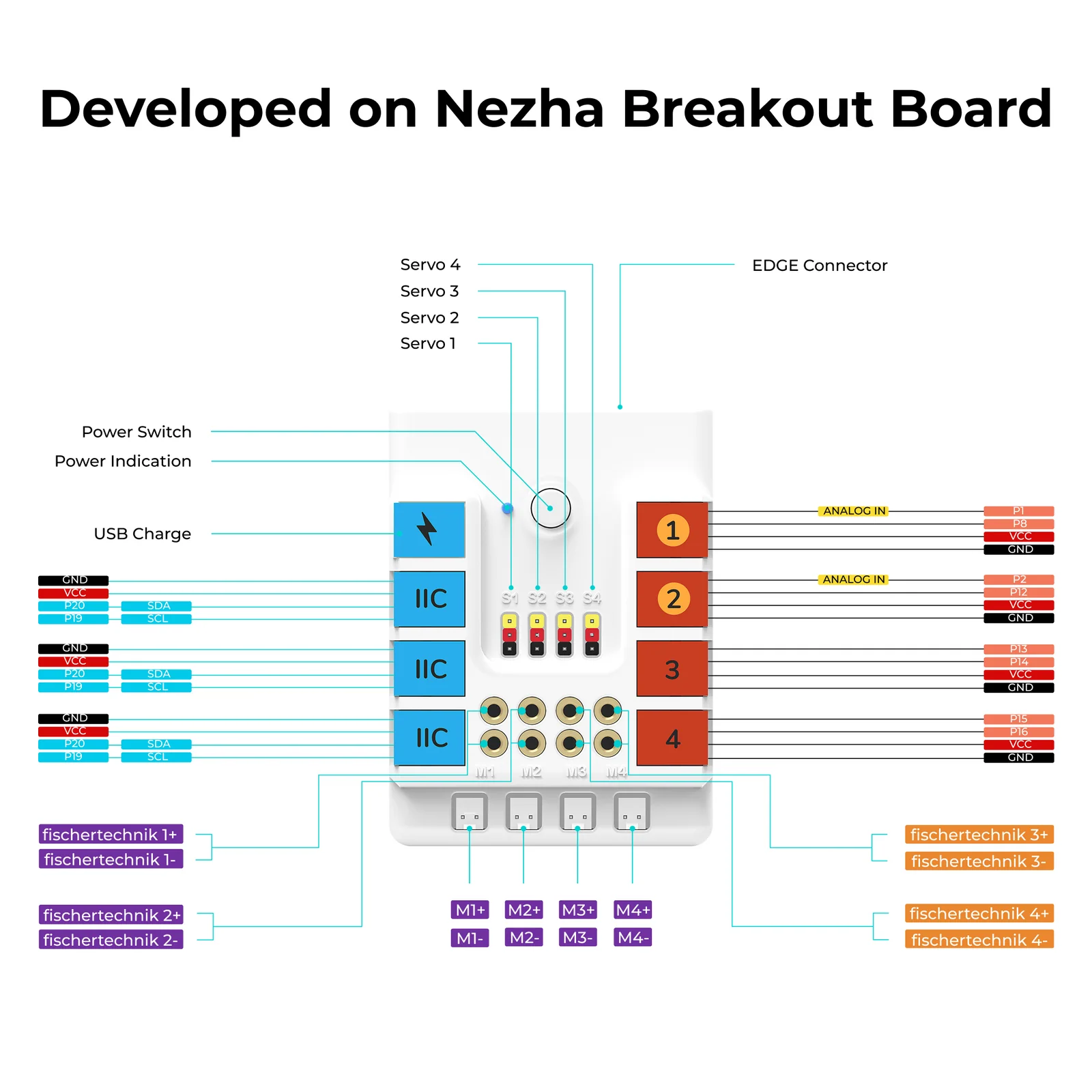
The core expansion board for micro:bit. Features dedicated servo ports, motor outputs, and 8 color-coded RJ11 sensor connectors — eliminating wiring errors and enabling rapid classroom setup.
🔧
4× Servo Motors
360° continuous-rotation and 180° precise-angle servo motors. Power all 32 curriculum cases — from pull-up robots and oscillating fans to smart obstacle-avoidance cars and robotic arms.
🔌
10× Sensor Modules
Includes ultrasonic (distance), IR line-following, soil moisture, temperature & humidity, ambient light, crash sensor, PIR motion, and more. Students build projects that genuinely respond to the real world.
🛠
35+ Structural Parts
Modular aluminum-alloy and plastic building pieces supporting all robot, mechanical, and smart-system case builds. Designed for repeated assembly and disassembly without degradation.
💻
micro:bit Compatible
Works with micro:bit V1 and V2 (not included). Students code in MakeCode block-based programming or Python text-based scripting — dual-language support for differentiated classrooms.
📚
32-Case Curriculum Guide
NGSS & CSTA-aligned lesson plans across 3 streams: Robots (Cases 1–20), Mechanical Engineering (Cases 21–24), and Smart Systems (Cases 25–32). Includes assembly guides, code examples, and STEAM discussion prompts.
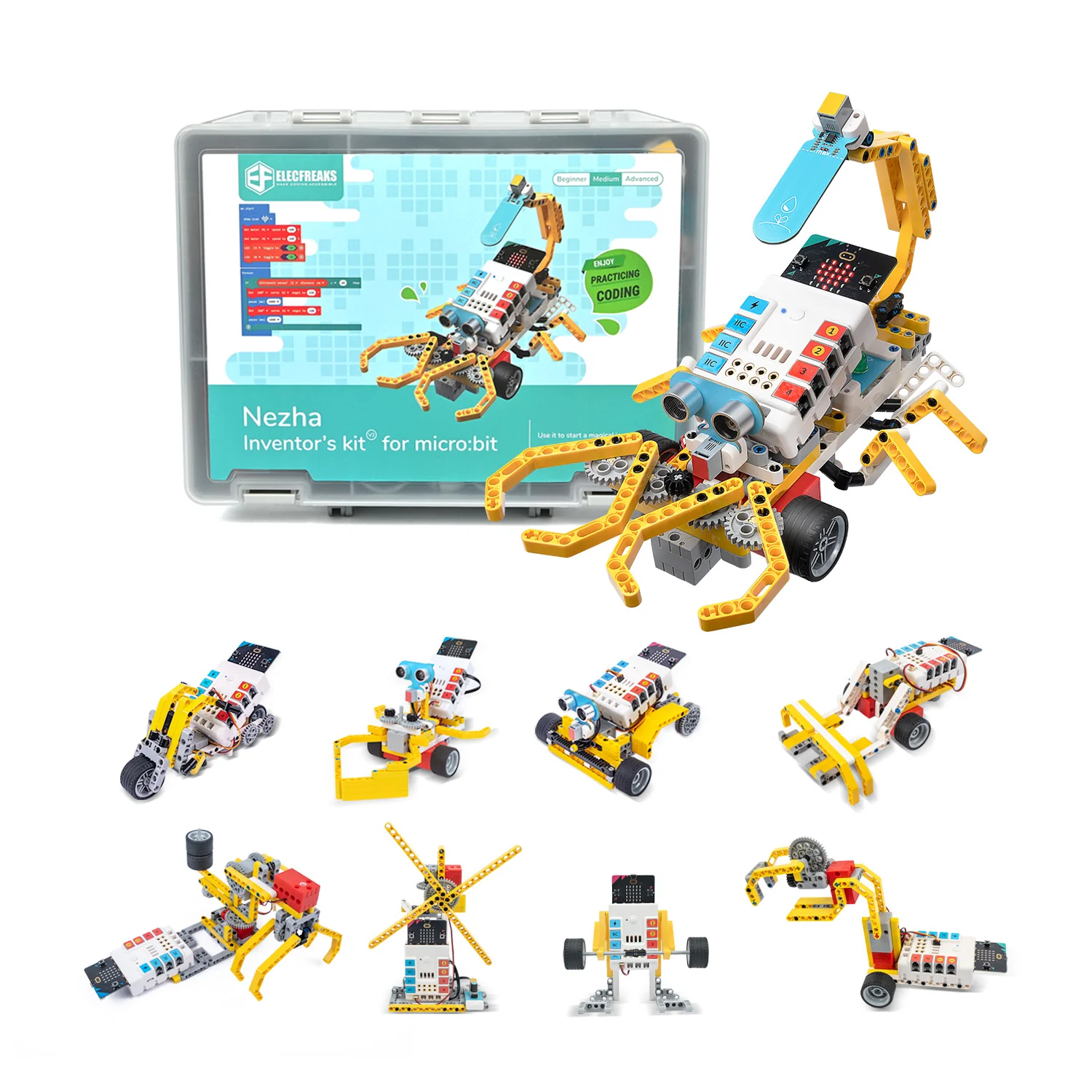
Nezha Inventors Kit V2 — robot builds from all 3 streams

Three Streams. 32 Cases. One Kit.

The Nezha Inventors Kit V2 delivers a structured STEAM engineering journey across three progressive curriculum streams — Robots, Mechanical Engineering, and Smart Systems — all coded with micro:bit using MakeCode or Python. Designed for Grades 5–8 and aligned to NGSS & CSTA standards.

🤖
Stream 1 — Robots (Cases 1–20)
Students build 20 robot models including a Pull-Ups Robot, Swimming Robot, Weightlifting Robot, Unicycle, Kaleidoscope, Dancing Robot, Crawling Robot, Walking Robot, Scorpion, Robotic Crab, Prawns, Walking Dog, Gyro Launcher, Robotic Arm, Seesaw, Automatic Whisk, Oscillating Fan, Counting Basketball Frame, and Shooting Device.
Stream 2 — Mechanical Engineering (Cases 21–24)
Four cases explore core engineering mechanisms: Forklift (lever principles), Rack & Pinion system, Motorcycle with Gears (gear ratios), and Excavator with Worm Gears. Students apply physics concepts of force, torque, and mechanical advantage in hands-on builds.
🚗
Stream 3 — Smart Systems (Cases 25–32)
Eight IoT and autonomous projects: two Obstacle Avoidance Cars, Line-Following Car, Smart Navigation Car, Flying Car, Traffic Light system, Automatic Gate, and Smart Clothes Rack. Students program real sensor-driven automation using MakeCode or Python.

What Students Develop

All 32 cases are mapped to NGSS and CSTA standards, developing skills across mechanical engineering, computational thinking, and real-world smart systems design.

⚙️
Mechanical Engineering Principles
Students apply levers, gears, cams, linkages, worm drives, and rack-and-pinion mechanisms across 24 robot and engineering cases. They connect classroom physics to real industrial machines and understand how force, torque, and mechanical advantage work together.
💻
Computational Thinking & Coding
Students program every case in MakeCode (blocks) or Python (text-based). They develop sequencing, conditionals, loops, state machines, and sensor-driven logic — the same patterns used by professional engineers designing autonomous vehicles and smart devices.
🚗
Smart Systems & Automation
Stream 3's 8 smart-system cases introduce IoT thinking: connecting sensors to actuators to solve real problems. Students design automatic gates, self-navigating cars, traffic management systems, and sensor-driven home automation — all coded with micro:bit.

Three Learning Streams

All 32 cases are NGSS & CSTA aligned for Grades 5–8 and come with complete lesson plans, assembly guides, and MakeCode / Python code examples.

🤖
Stream 1 · Cases 1–20
Robots
Cases 1–5
🏋
Athletic Robots
Cases
Pull-Ups Robot · Swimming Robot · Weightlifting Robot · Unicycle Robot · Kaleidoscope Robot. Students explore rotary and linear motion using servo motors and gear assemblies, discovering how mechanical design enables lifelike movement.
Servo Motors Rotary Motion Gear Systems MakeCode
Cases 6–10
🦡
Motion Robots
Cases
Dancing Robot · Crawling Robot · Walking Robot · Scorpion Robot · Mechanical Crawler. Students investigate biomechanics and linkage mechanisms to replicate animal and human movement patterns using structural parts and servo control.
Linkage Mechanisms Biomechanics Servo Sequences Python
Cases 11–15
🦪
Animal & Utility Robots
Cases
Robotic Crab · Prawns Robot · Walking Dog · Gyro Launcher · Robotic Arm. Students build multi-limb animal models and utility tools, applying concepts of balance, torque, and range of motion while programming coordinated multi-servo behaviour.
Multi-Servo Control Balance & Torque Robotic Arm Gyroscope Concepts
Cases 16–20
🏈
Mechanical Machines
Cases
Seesaw (Levers) · Automatic Whisk · Oscillating Fan · Counting Basketball Frame · Shooting Device. Students apply simple machine principles — levers, cranks, cams — to build functional, programmable devices that solve real tasks.
Simple Machines Cams & Cranks Counting Logic MakeCode / Python
Stream 2 · Cases 21–24
Mechanical Engineering
Case 21
🚛
Forklift
Engineering Concept
Students build a functional forklift that raises and lowers a load using servo-driven levers. Explores mechanical advantage, load vs. effort, and how industrial machinery applies simple physics to move heavy objects efficiently.
Lever Principles Load & Effort Servo Drive
Case 22
🔄
Rack & Pinion System
Engineering Concept
Students build and program a rack-and-pinion mechanism that converts rotational servo motion into precise linear displacement — the same mechanism used in car steering systems and 3D printers. Reinforces gear ratio and displacement concepts.
Rack & Pinion Rotational → Linear Gear Ratios
Case 23
🏍
Motorcycle with Gears
Engineering Concept
A motorcycle model demonstrating how multi-stage gear systems change speed and torque. Students experiment with different gear combinations to understand why vehicles shift gears — connecting physics to real-world transportation engineering.
Multi-Stage Gears Speed vs. Torque Gear Chains
Case 24
🚳
Excavator with Worm Gears
Engineering Concept
Students build a working excavator arm using worm gear assemblies — which provide high reduction ratios and self-locking capability. Explores why construction machinery uses worm gears for precision, load holding, and safety under weight.
Worm Gears Self-Locking High Reduction Ratio
🚗
Stream 3 · Cases 25–32
Smart Systems
Cases 25–26
🚘
Obstacle Avoidance Cars
Smart Concept
Two progressive variants of autonomous obstacle-avoidance vehicles. Students program ultrasonic sensor-based detection and servo-motor steering to navigate around objects — learning feedback loops, threshold logic, and autonomous decision-making in a vehicle context.
Ultrasonic Sensor Autonomous Logic Threshold Control
Cases 27–28
📌
Line Following & Navigation
Smart Concept
Smart Line-Following Car and Smart Navigation Car. Students program IR sensor arrays to track paths and navigate waypoints — exploring how autonomous vehicles follow routes and make directional decisions based on environmental signals.
IR Line Sensors Path Following Navigation Logic
Cases 29–30
🚥
Flying Car & Traffic Light
Smart Concept
A futuristic hybrid Flying Car model and a programmable Traffic Light system with LED sequencing and pedestrian gate servo. Students program timed state machines and explore how urban infrastructure systems manage traffic flow and safety.
State Machines LED Sequencing Servo Gate
Cases 31–32
🏛
Automatic Gate & Smart Clothes Rack
Smart Concept
An Automatic Gate using PIR motion detection and a Smart Clothes Rack that extends/retracts based on rain/light sensor input. Students program real IoT automation solutions — connecting sensor data to actuator responses in practical smart-home scenarios.
PIR Motion Sensor Rain / Light Sensor IoT Automation

Explore every case — introductions, objectives, step-by-step assembly images, and live GIF demos

📚 View All 32 Cases →

Nezha Inventors Kit V2

Real product images showing the full kit, key components, and sample case builds from all three learning streams.

Nezha Inventors Kit V2 — complete kit with all robot builds
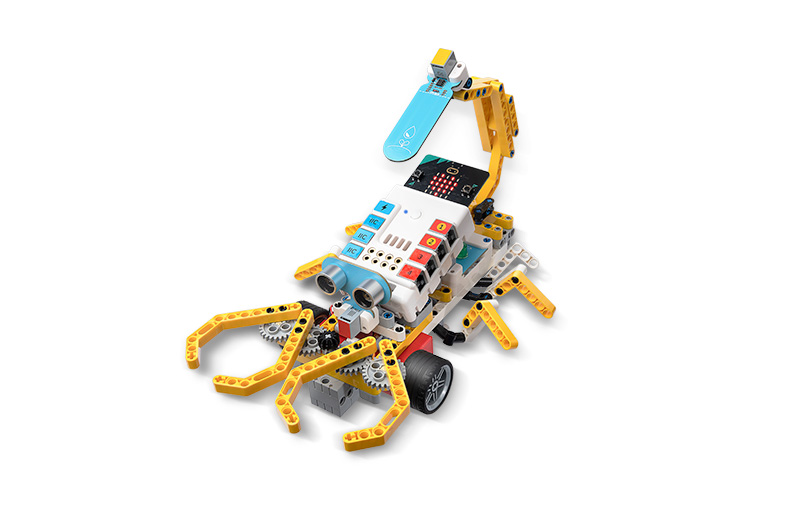
Nezha Inventors Kit V2 — scorpion robot build
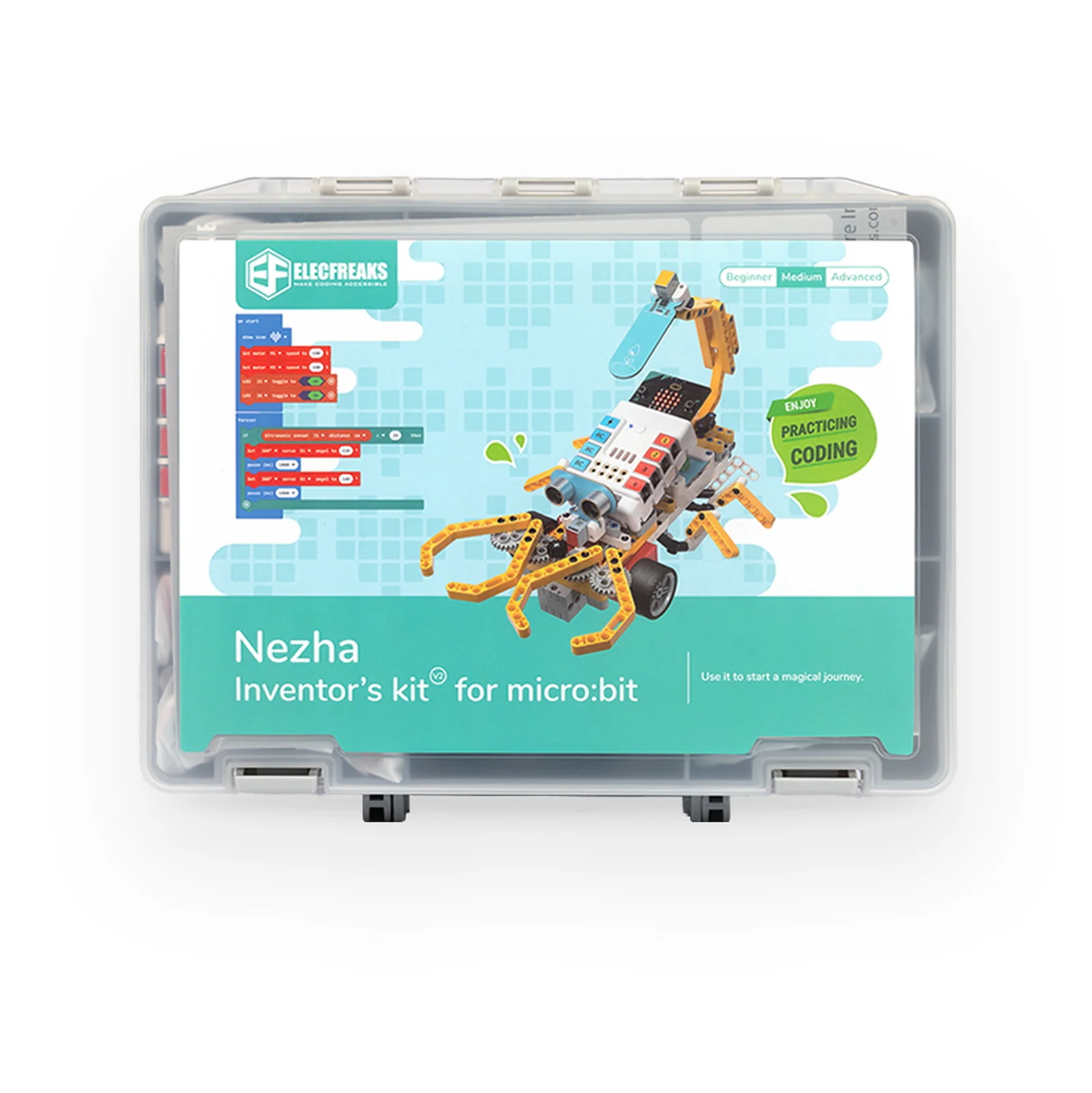
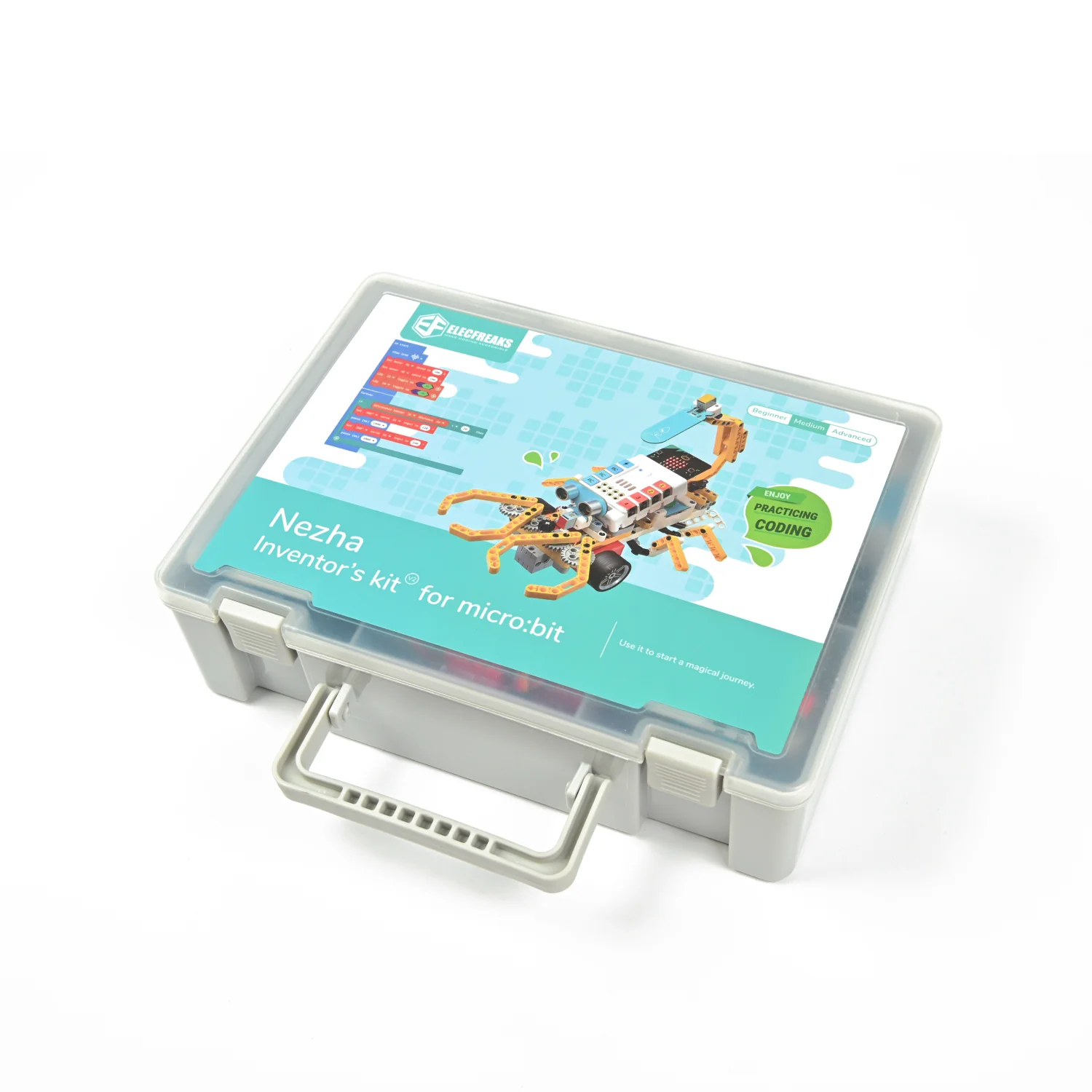
Nezha Inventors Kit V2 — kit box front
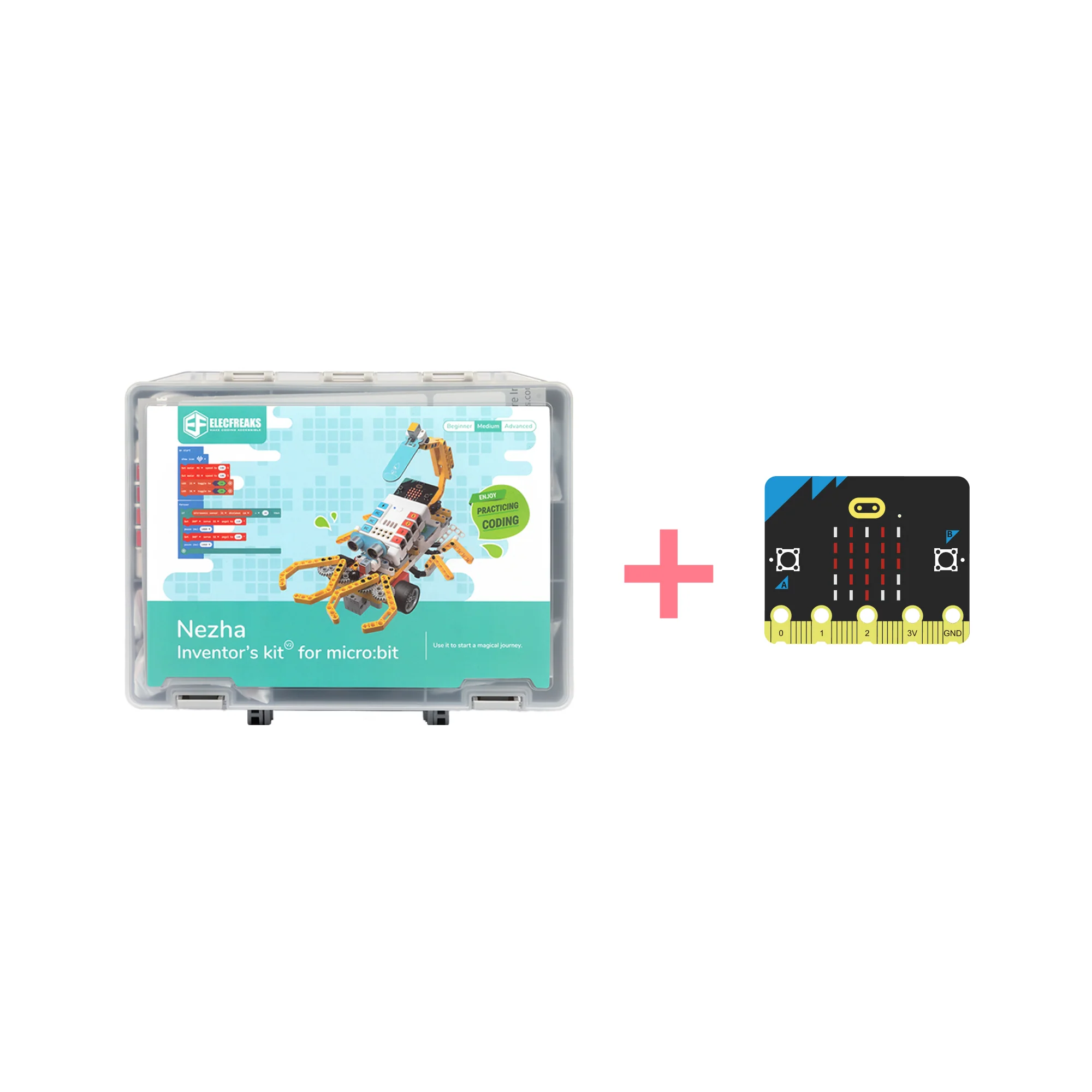
Nezha Inventors Kit V2 + micro:bit
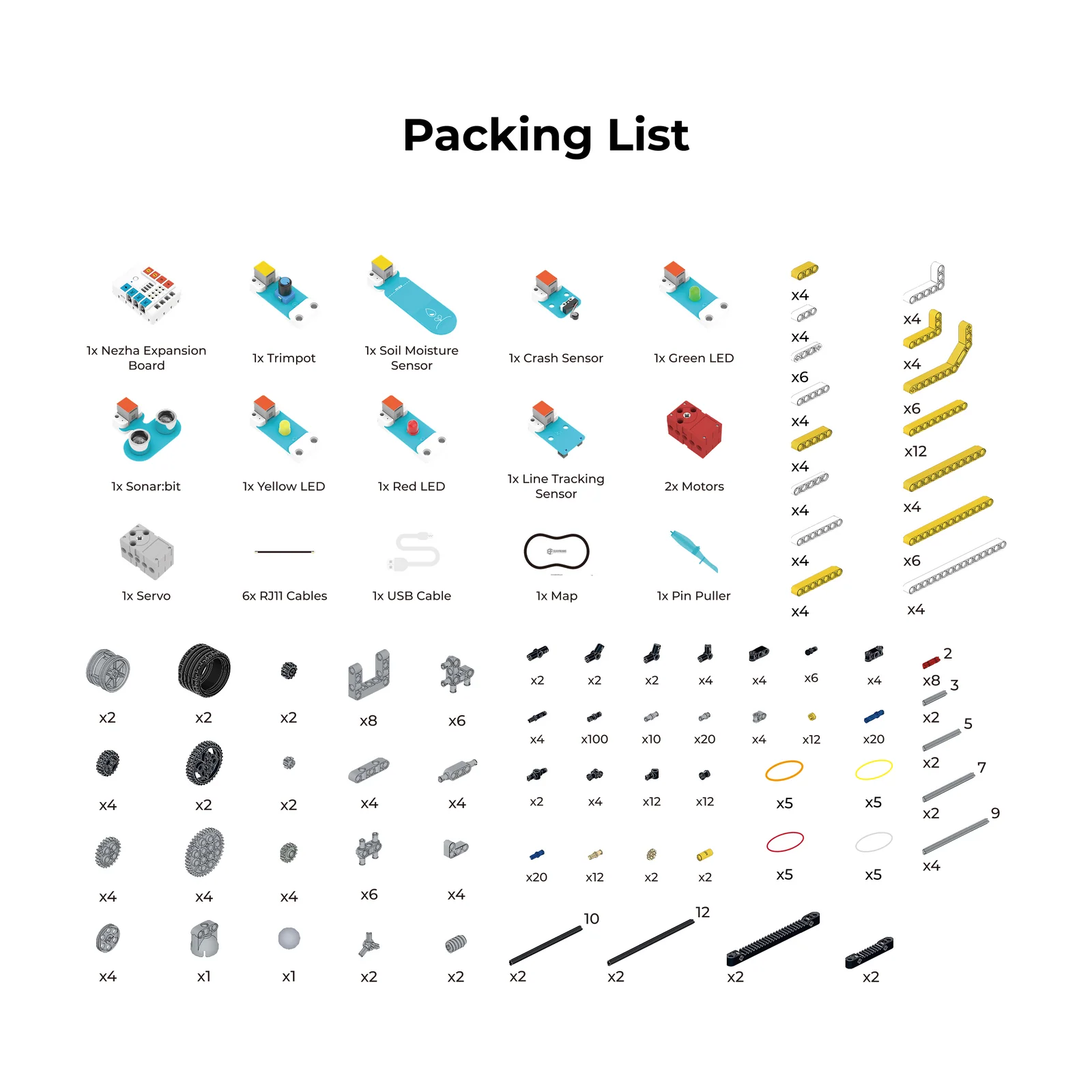
Nezha Inventors Kit V2 — full packing list
Nezha Inventors Kit V2 — kit angle view
Nezha Breakout Board V2 — port diagram

Designed for Grades 5–8

The Nezha Inventors Kit V2 is purpose-built for middle school learners, with 32 cases spanning beginner robot builds to advanced autonomous smart systems. All cases are aligned to NGSS and CSTA standards.

Foundation
Grades 5–6
Robot Builds & Simple Machines
Build and program athletic robots: Pull-Ups, Swimming, Weightlifting, Unicycle, Kaleidoscope
Write first programs in MakeCode block-based coding with servo control
Explore motion and linkage mechanisms through crawling, walking, and dancing robots
Apply simple machine principles: levers (Seesaw), cams (Whisk), cranks (Fan)
Follow iterative design — build, test, improve — using structured lesson plans
Applied
Grades 7
Mechanical Engineering
Build a Forklift using lever and pulley principles to lift and lower loads
Construct a Rack & Pinion mechanism converting rotary to linear motion
Program a Motorcycle with Gears — exploring gear ratios and speed vs. torque
Build an Excavator with Worm Gears demonstrating self-locking and high reduction
Document mechanical design choices and relate them to real-world engineering contexts
Advanced
Grade 8
Smart Systems & Automation
Program autonomous Obstacle Avoidance Cars using ultrasonic sensor feedback
Build Line-Following and Smart Navigation Cars with IR sensor arrays
Design a Traffic Light system using state machines and LED sequencing in Python
Create an Automatic Gate (PIR sensor) and Smart Clothes Rack (rain/light sensors)
Write modular Python code — functions, loops, conditionals — for real IoT automation

Full Specifications

Nezha Inventors Kit V2 — Kit Overview
Grade RangeGrades 5–8
Age Suitability10–14
Programming LanguagesMakeCode, Python
Compatible Boardmicro:bit V1 & V2 (not included)
Sensors Included10 modules
Structural Parts35+ pieces (aluminum alloy & plastic)
Servo Motors4× (180° and 360°)
Curriculum Cases32 cases across 3 streams
Standards AlignmentNGSS & CSTA
Sensor InterfaceRJ11 (color-coded, anti-reverse)
CertificationsCE / RoHS
Nezha Breakout Board V2 — Technical Parameters
Servo Ports4× dedicated servo outputs
Motor Ports4× motor drive outputs
Sensor Ports8× RJ11 sensor inputs
Charging PortType-C (fast charge)
Charging Time~50 minutes
Battery LifeUp to 4 hours
Power SwitchPhysical toggle
Working Voltage6.4 V – 8.4 V
Sensor Output3.3 V
micro:bit ConnectorEdge connector (top-mount)

Ready to Invent?

Contact our STEM education team for pricing, curriculum alignment resources, and professional development support across the GCC and MENA region.