Elecfreaks · micro:bit Series
Smart Home & IoT Automation

micro:bit
Smart Home Kit

Build your own smart home from scratch. Students program real-world automations — voice-activated lights, temperature-controlled fans, automated windows, and more — using micro:bit and a rich suite of sensors and actuators.

🏠 11 Smart Home Projects 🔌 8 Sensors & Actuators ⛏ Servo & Motor Control 🎓 Grades 5–9
Request a Quote →
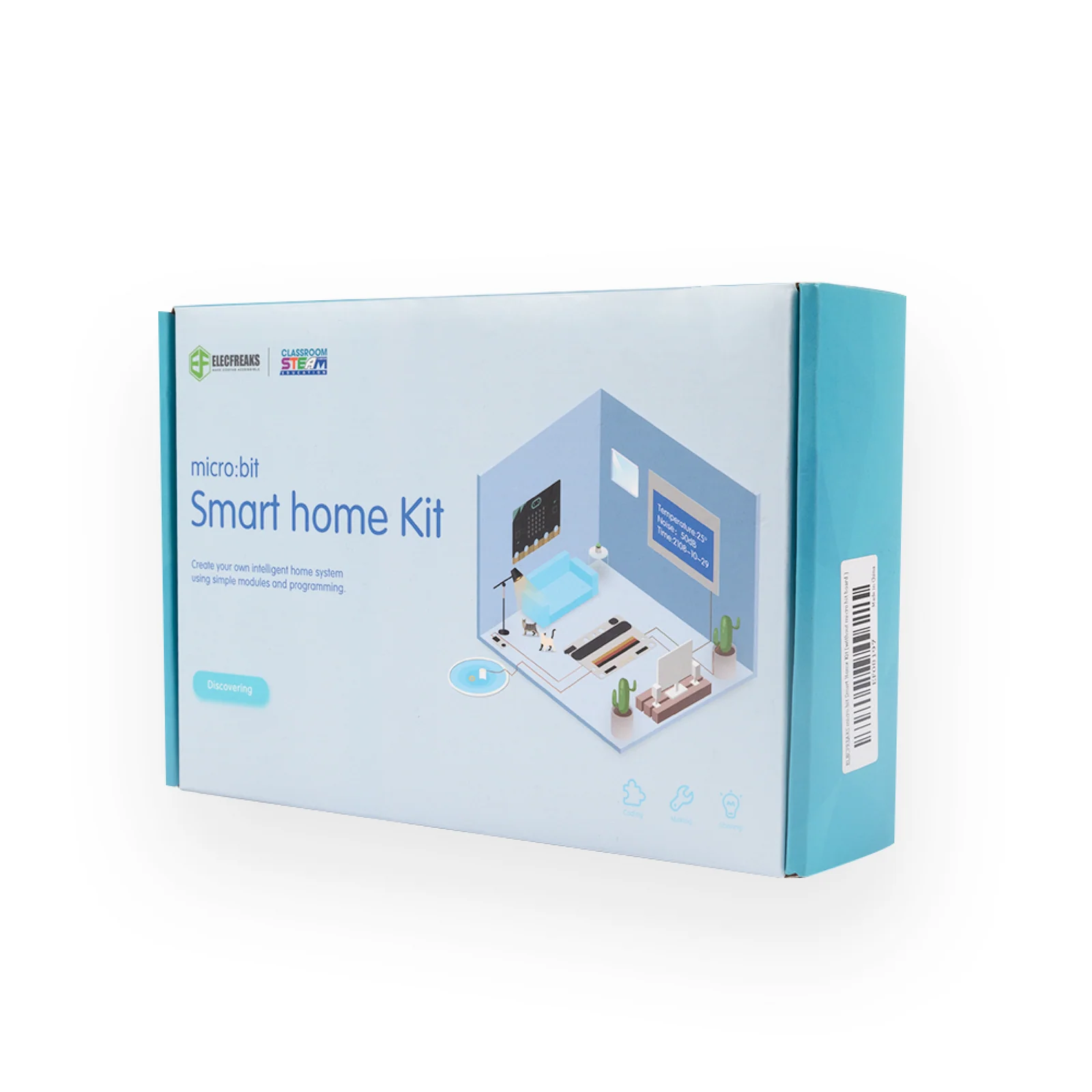
micro:bit Smart Home Kit box
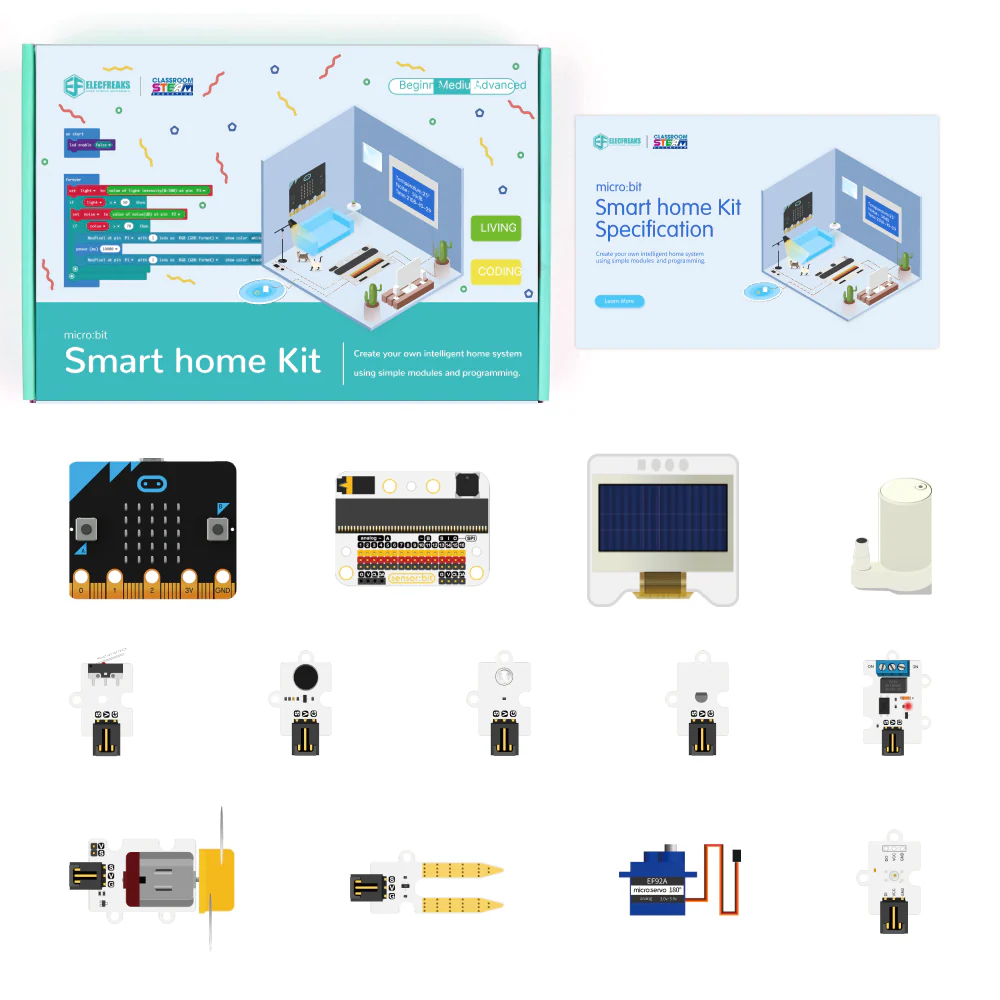
micro:bit Smart Home Kit components
11
Projects
8+
Sensors
IoT
Automation
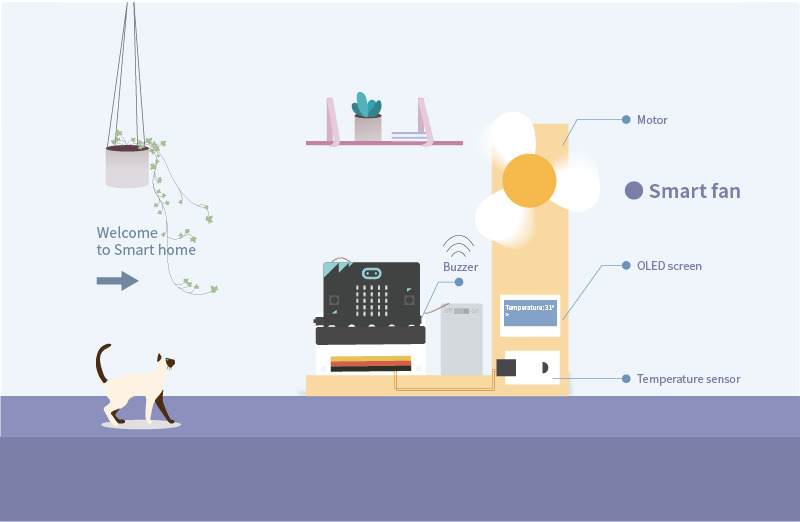
Smart Fan project
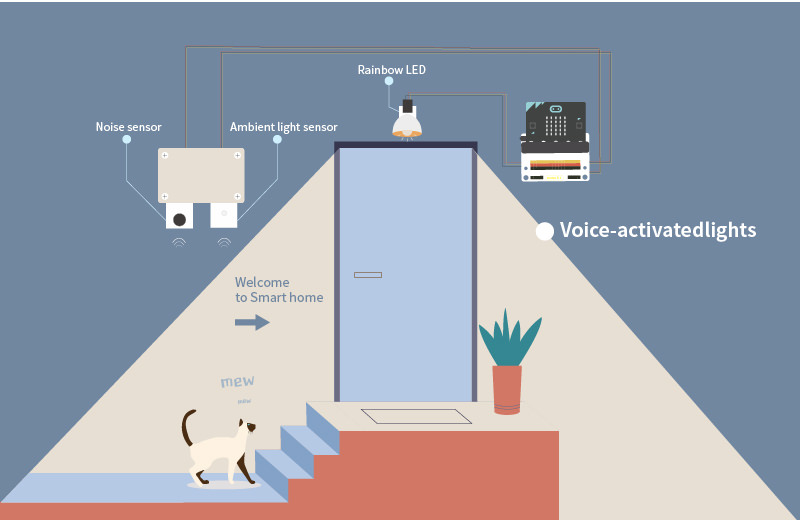
Voice-Activated Lights project

Build a Real Smart Home, Line by Line

The micro:bit Smart Home Kit transforms students into home automation engineers. By building hands-on scenarios — a smart windowsill, an automated wardrobe, a self-monitoring fish tank — students gain real experience in sensor programming, motor control, and intelligent system design.

🎉
11 Progressive Smart Home Scenarios
From voice-activated lights to intrusion detection, each project builds on the last — developing complexity and confidence in a natural progression.
Sensors + Motors + Display
Students experience the full IoT loop: sense → process → actuate. Combine noise, light, temperature, and crash sensors with servos, DC motors, a pump, and an OLED display.
💻
Programmable with MakeCode & Python
Works with Microsoft MakeCode's block-based editor for beginners, then scales to Python and JavaScript for more advanced learners — no platform switching required.

Designed for Real-World Engineering

Every component connects a classroom concept to a real system students interact with every day at home — making learning immediate, relevant, and unforgettable.

🏠
Real Home Scenarios
Students build replicas of real-world home systems — smart doors, automated fans, plant watering — not abstract exercises. Every project mirrors actual IoT engineering.
🔌
Diverse Sensor Suite
Eight different input and output modules — sound, light, temperature, crash, soil moisture, relay, servo, and DC motor — expose students to the full range of IoT sensing and actuation.
💻
micro:bit + MakeCode / Python
Progressive coding from visual blocks to text-based Python — the same hardware grows with the student's skill level from beginner to advanced.
📈
OLED Data Display
The integrated OLED screen lets students display live sensor readings — temperature, noise levels, timestamps — building data visualization and feedback loop understanding.
🤖
Motor & Servo Control
DC motor for fans and rotating mechanisms, 180° servo for doors and windows, and a submersible pump for plant watering — introducing electromechanical control concepts.
🏭
Cross-Curriculum STEAM
Projects naturally span physics (circuits, motors), computer science (programming logic), environmental science (sensors), and engineering design — all in one kit.

Key Hardware Components

A complete ecosystem of sensors, actuators, a controller, and a display — everything needed to build a functioning smart home automation system from day one.

Controller
micro:bit + 3V sensor:bit
The micro:bit is the programmable brain — small, powerful, and accessible. The 3V sensor:bit expansion board provides clean, labeled ports for every sensor and actuator in the kit, making wiring intuitive and error-free.
ProgrammingMakeCode / Python / JavaScript
Board Voltage3V (sensor:bit)
Display0.96" OLED (128 × 64)
PowerUSB Cable + Crystal Battery Box
Sensors
Environmental Sensor Suite
Six input sensors covering the key home environment variables — enabling students to build systems that respond intelligently to sound, light, temperature, physical contact, moisture, and impact.
Noise SensorSound level detection
Light SensorAmbient luminosity
TMP36 Temp SensorThermal monitoring
Crash SensorPhysical contact / impact
Soil Moisture SensorWater level / hydration
Actuators
Motor, Servo & Pump
Three types of actuators give students full control of physical systems — from spinning a fan blade to opening a door to watering a plant. Combined with a relay for switching, this covers the core of real home automation hardware.
DC MotorFan / rotation control
180° ServoDoor / window / arm control
Submersible PumpAutomated plant watering
RelayElectronic switching control
Output
OLED Display & Rainbow LED
The OLED screen provides real-time text readouts of sensor data — temperature, noise levels, timestamps — while the Rainbow LED module adds color-coded visual feedback for status and alert conditions across all projects.
OLED Size0.96" / 128 × 64 px
OLED TypeSelf-luminous, low power
Rainbow LEDProgrammable color output
InterfaceE-Blocks (labeled GVS ports)

What's Included

Every sensor, actuator, and accessory needed to build all 11 smart home projects — ready out of the box.

🤖
micro:bit
× 1 (Optional)
🔌
3V sensor:bit
× 1
📺
OLED Screen
× 1
🔊
Noise Sensor
× 1
💡
Light Sensor
× 1
🌡️
TMP36 Temp Sensor
× 1
🔻
Crash Sensor
× 1
🌿
Soil Moisture Sensor
× 1
🌈
Rainbow LED
× 1
DC Motor
× 1
🔄
180° Servo
× 1
💧
Submersible Pump
× 1
🔑
Relay
× 1
🔋
Crystal Battery Box
× 1
📸
USB Cable + Manual
× 1 each

Smart Home Scenarios

Real project illustrations showing how the kit works across different smart home environments.

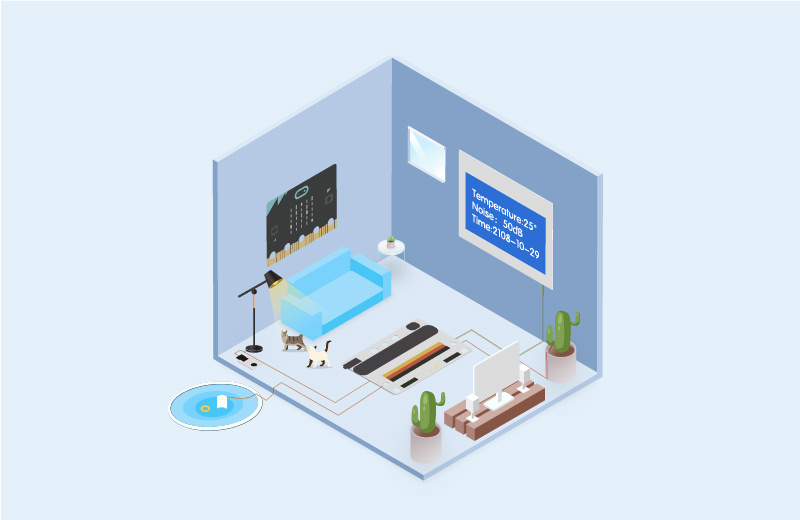
Smart Home Overview
Smart Home Overview
Smart Fan Project
Smart Fan (Temperature-Controlled)
Voice-Activated Lights

11 Smart Home Challenges

Each project is a self-contained smart home engineering challenge that builds sensor programming, actuation logic, and system design progressively.

01
Voice-Activated Lights
Use the noise sensor and Rainbow LED to build lights that switch on when they detect a sound — just like a real smart home clap-switch or voice command system.
02
Smart Fan
Program the TMP36 temperature sensor to automatically spin the DC motor fan when temperature rises above a threshold, displaying live readings on the OLED screen.
03
Automated Window
Connect the light sensor and 180° servo to open and close a window model automatically based on ambient brightness — mimicking real smart blinds.
04
Smart Wardrobe
Build a wardrobe that uses the crash sensor to detect opening and the Rainbow LED to illuminate the interior automatically — just like modern smart furniture.
05
Fish Tank Monitor
Use the soil moisture sensor as a water level detector to trigger the submersible pump, simulating an automated top-up system for an aquarium or plant watering station.
06
Intrusion Detection
Combine the crash and noise sensors with the buzzer to build a simple home security alarm — triggering an alert when unexpected contact or sound is detected.
07
Smart Door
Use the servo motor and crash sensor to build an automatic door that opens when someone approaches and closes after a timed delay — simulating real smart entry systems.
08
Noise Level Meter
Program the noise sensor and OLED display to measure and visualize ambient sound levels in real time — building a functional decibel monitor for any room.
09
Health & Comfort Monitor
Combine the temperature sensor, light sensor, and OLED display to track room comfort — alerting when conditions fall outside healthy ranges for temperature or lighting.
10
Automated Plant Watering
Use the soil moisture sensor to detect dry soil and trigger the submersible pump to water plants automatically — a fully functional smart irrigation system.
11
Smart Home Dashboard
Connect all sensors simultaneously and program the OLED to display a live dashboard showing temperature, noise, light levels, and system status — the ultimate integration project.

Full Specifications

Smart Home Kit — General
Product Namemicro:bit Smart Home Kit
SKUEF08197 / EF08198
Controllermicro:bit + 3V sensor:bit
ProgrammingMakeCode, Python, JavaScript
DifficultyBeginner → Advanced
Projects11 smart home scenarios
PowerUSB Cable / Crystal Battery Box
Display0.96" OLED (128 × 64 px)
Sensors & Actuators
Noise SensorSound / voice detection
Light SensorAmbient luminosity
TMP36 TemperatureThermal monitoring
Crash SensorPhysical contact detection
Soil MoistureWater level / plant hydration
Rainbow LEDProgrammable color output
DC MotorFan / rotation (relay-switched)
180° ServoDoor / window / arm actuation
Submersible PumpWater circulation / plant watering
RelayElectronic circuit switching

Skills Students Develop

💻
Programming & Logic
Conditionals, loops, sensor-triggered events, and output control through MakeCode blocks progressing to Python text-based coding.
Electromechanical Systems
Controlling motors, servos, pumps, and relays introduces the electromechanical principles behind real home appliances and industrial automation.
🏠
IoT System Design
Designing sense-process-actuate feedback loops mirrors how real smart home systems — thermostats, security systems, irrigation — are engineered professionally.
🤝
Problem Solving & Iteration
Debugging sensor responses, tuning thresholds, and improving automation logic builds resilient engineering thinking and iterative design habits.

Bring Smart Home Engineering to Your Classroom

Contact us for pricing, curriculum alignment guides, and professional development support.